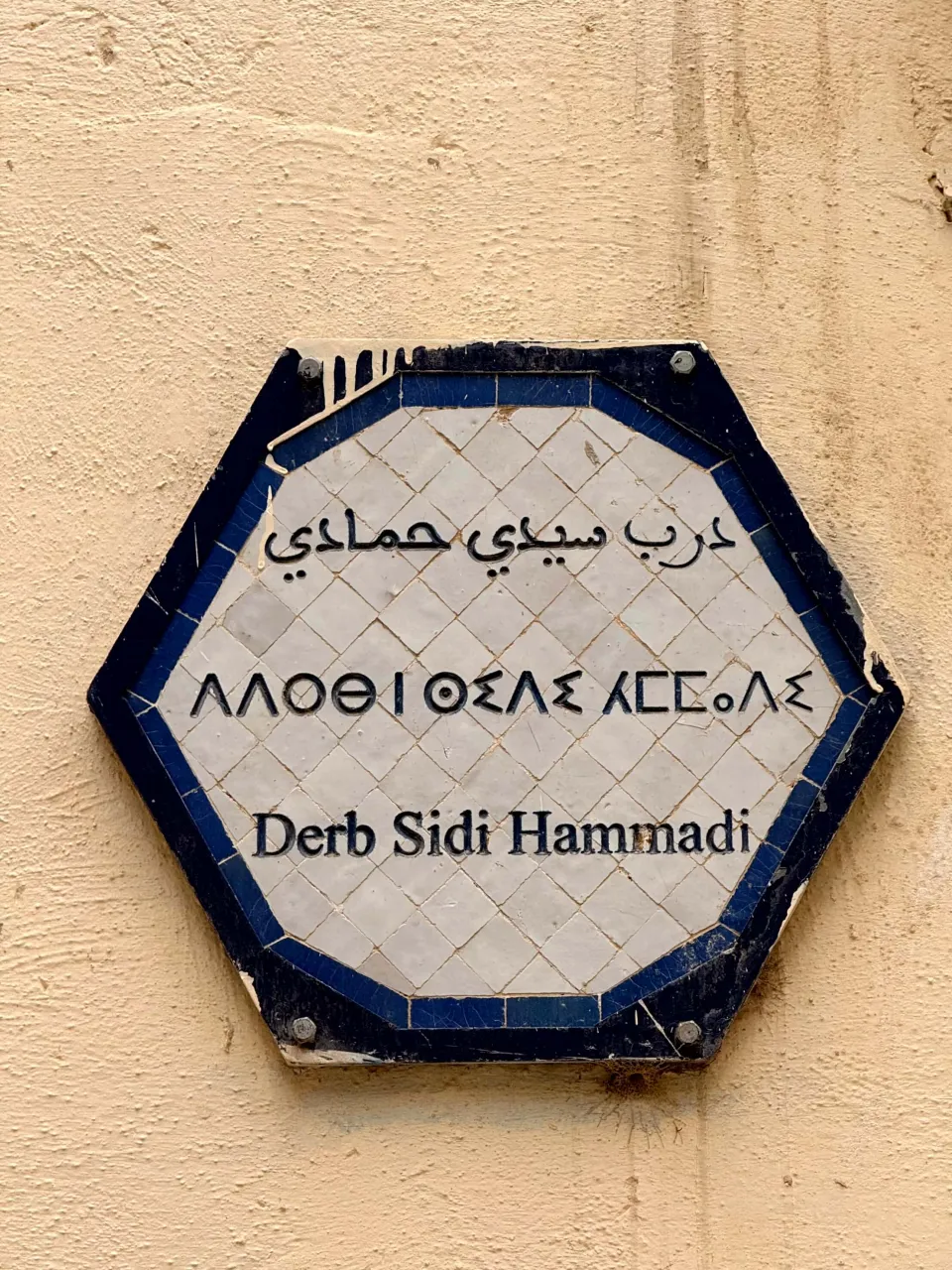
Walk five minutes in the Fes medina and you will have read the same street name three times on every plaque. The line in the middle, in letters that look like circles, crosses and brackets, is Tamazight, the Amazigh language, written in its own alphabet, Tifinagh. This is the plaque of our own lane, a few steps from the door of Dar Fayrouz.
Three lines on every plaque
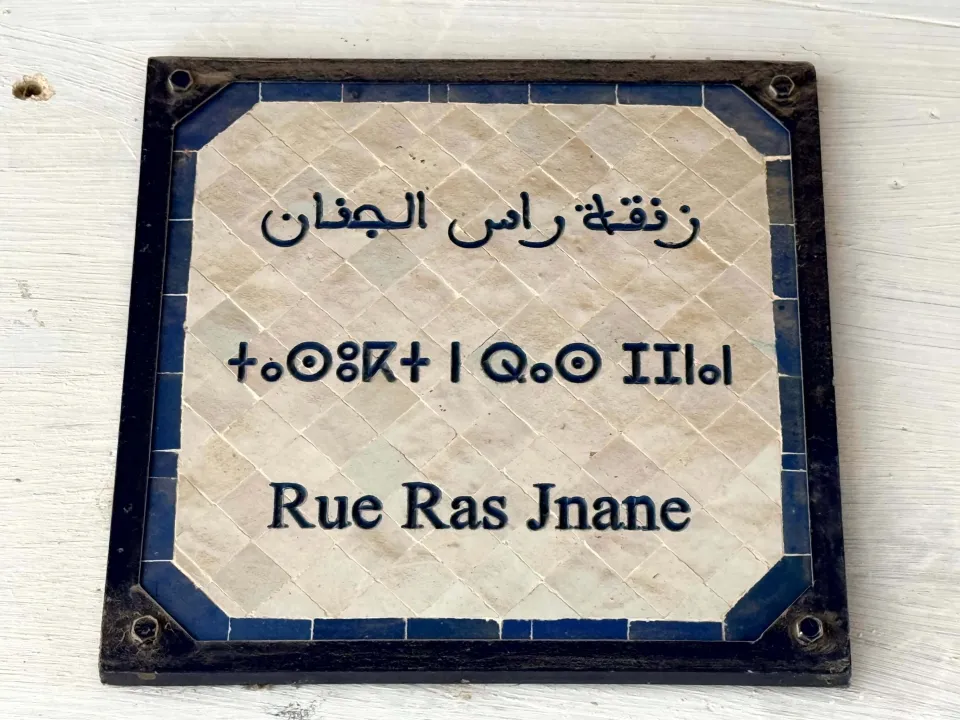
The top line is Arabic, the bottom line French, and the middle one Tamazight. Tamazight has been an official language of Morocco since the constitution of 2011, which names it, in Article 5, alongside Arabic as "a common heritage of all Moroccans". Since then it has appeared on public buildings, road signs and the street plaques of the old cities.
The shape of the plaque also carries a message for walkers: in Fes, a hexagonal plaque marks a closed lane and a rectangular one a street that goes through. We explain how to use it in our arrival guide.
Amazigh or Berber: which word is right?
Amazigh is the name the people use for themselves. It is usually translated as "free person"; the plural is Imazighen, and the language is Tamazight. Berber is a name given from the outside. It goes back to the Greek barbaros, the word for anyone who did not speak Greek, which passed into Latin and then Arabic as a label for the peoples of North Africa.
So "Berber" is not a spelling of Amazigh; it is a foreign word for the same people, and many Imazighen find it inaccurate or belittling. You will still meet it in guidebooks, museums and on menus. On this website we write Amazigh, as Moroccan institutions do.
Tifinagh, the Amazigh alphabet
Tifinagh descends from an ancient script of North Africa found carved on rocks and stelae, and the Tuareg of the Sahara kept writing it through the centuries. Morocco created the Royal Institute of Amazigh Culture (IRCAM) in 2001, and in 2003 adopted a standardised Tifinagh to teach Amazigh in schools. Its best-known letter is yaz, often read as a figure with raised arms, the free person: it stands at the centre of the Amazigh flag.
The Amazigh calendar and Yennayer
The Amazigh calendar is an old farming calendar that follows the seasons. Its first month is Yennayer, and the New Year, also called Yennayer, falls on 14 January in Morocco. Years are counted from 950 BC, when Sheshonq I, a king of Libyan Amazigh origin, took the throne of Egypt. That is why 2026 is the year 2976, and why 14 January 2027 opens the year 2977.
In May 2023 King Mohammed VI made Yennayer an official paid public holiday; it has been celebrated as one since 14 January 2024. Families mark the night with a shared meal, often couscous or a barley dish, and in many homes a date stone is hidden in the plate: whoever finds it will have a lucky year.
Where to meet Amazigh culture from Fes
Fes is an Arabic-speaking city, but the Middle Atlas begins a short drive to the south. Around Ifrane and Azrou, villages speak Central Atlas Tamazight, and the cedar forests and markets of the region are Amazigh country. Our day trips include Ifrane and the Azrou cedar forest, and we are happy to tell you more over a mint tea at the riad.
Sources: Moroccan constitution of 2011, Article 5; Standard Moroccan Amazigh; Morocco World News on Yennayer 2976.